
Quick Summary
When an automatic driveway gate stops working due to electrical faults, mechanical binding, or sensor issues, prompt gate motor repair is essential to restore secure access and maintain critical UL 325 safety compliance. Everest Gate Service Santa Clara provides rapid-response diagnostics that accurately identify whether an operator needs isolated component fixes or a full replacement, protecting property owners from unnecessary system overhauls. After reading this guide to identify key operator failure symptoms and safety risks, homeowners can contact Everest Gate Service Santa Clara to schedule a free on-site estimate or call for 60-minute emergency gate motor repair.
Gate Motor Repair: Driveway Access and Safety Considerations
When an automated driveway gate refuses to open or close, gate motor repair may restore access when the fault is serviceable. A malfunctioning operator is not just an inconvenience; it can also present mechanical and electrical hazards. Professional diagnostic testing from specialists like Everest Gate Service Santa Clara helps determine whether an operator requires component-level repair or full replacement.[5]
Why Did My Gate Motor Stop Working?
An electric gate motor typically stops operating due to power interruptions, obstructions, dirty or misaligned safety sensors, incorrectly adjusted limit switches, or mechanical and electrical motor faults. Determining the exact cause requires systematic electrical and mechanical testing.
Immediate Triage for Stuck Automatic Gates
Never attempt to force a stuck gate panel without first disengaging the operator. Forcing the gate against a locked gearbox can cause mechanical damage. Follow these initial troubleshooting steps:
- Check the power source: Inspect your main electrical panel and dedicated exterior sub-panels to verify whether a power interruption or tripped breaker has occurred.
- Inspect the safety sensors: Check for obstructions and clean dirty or misaligned safety sensors.
- Check limits and mechanical components: Inspect for incorrectly adjusted limit switches, physical obstructions, or mechanical and electrical motor faults.
When to Call a Professional Technician
If the gate experiences persistent electrical or mechanical faults, limit switch issues, or motor failures, troubleshooting should be handled by qualified service technicians with proper diagnostic tools, such as the team at Everest Gate Service Santa Clara.
What Does Gate Motor Repair Cost?
The cost of repairing an automatic gate operator depends directly on the root cause of the breakdown, the availability of manufacturer parts, and the physical condition of the gate hardware.
Service Categories and Scope
| Service Category | Typical Scope of Work | Primary Turnaround Factors |
|---|---|---|
| Component Repair | Capacitors, relays, limit switches, wiring, safety sensors | Part availability and diagnostic complexity |
| Operator Replacement | Motor unit, gearbox, mounting brackets, primary control board | Operator specifications, physical footprint, power supply matching |
| Complete System Overhaul | New operator, entrapment protection sensors, access control stations, track work | Site wiring, structural gate alignment, site requirements |
Key Cost Drivers: Component Repairs vs. Full Replacement
Key variables dictate repair expenses: the age and brand of the operator, the physical condition of the gate track or hinges, and the nature of the electrical or mechanical fault.
Can an Electric Gate Motor Be Repaired or Does It Need Replacement?
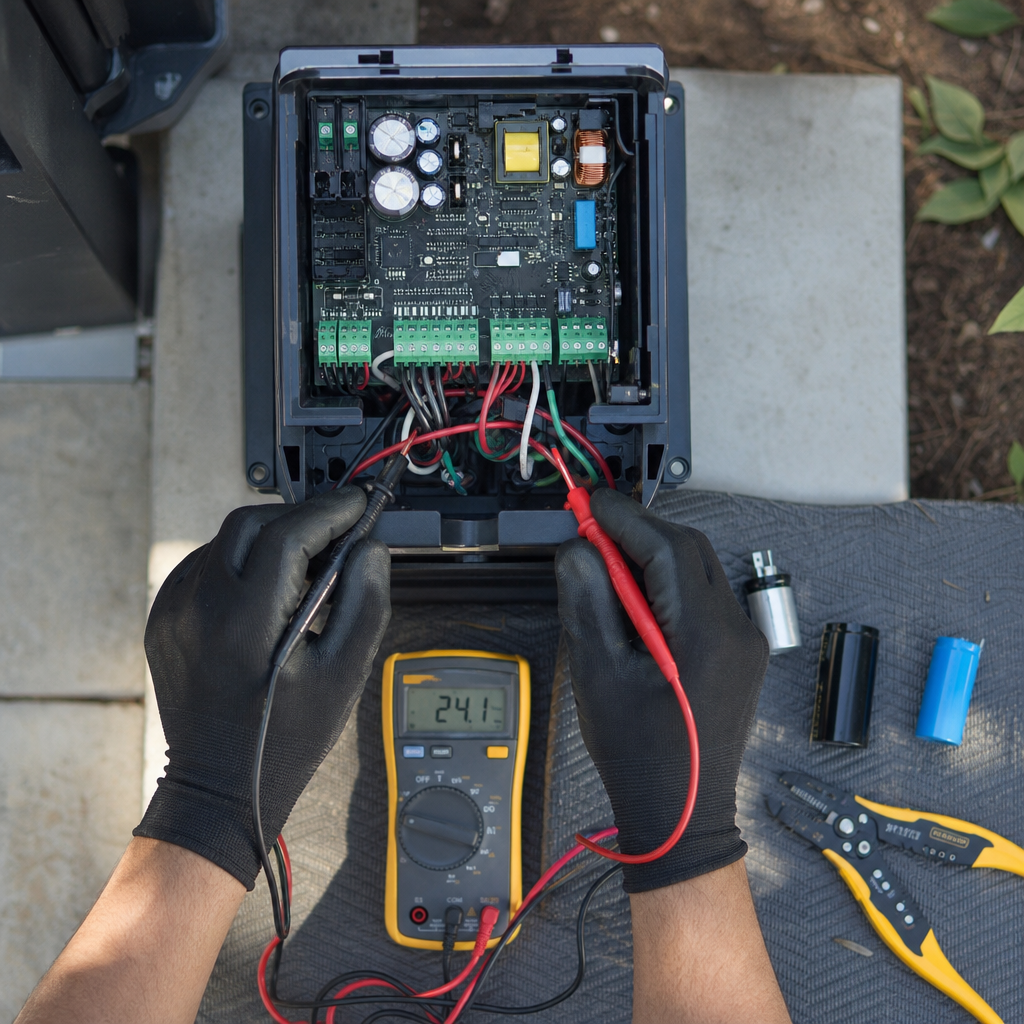
Either repair or replacement may be appropriate depending on the specific fault, component serviceability, overheating, abnormal current draw, severe wear, repeated capacitor failure, torque loss, grinding, and vibration.
When an operator exhibits severe internal wear, ongoing torque loss, or continuous overheating, full replacement may be warranted over isolated repairs.
Safety Standards and UL 325 Compliance
Safety standard UL 325 covers automatic vehicular gate operators and hazards including entrapment, electric shock, fire, and casualty risks. Under this standard, automatic gate systems must feature at least one independent primary and one independent secondary means of entrapment protection.[4]
Industry safety data underscores the importance of these standards. NEISS is a national probability sample of U.S. hospitals used to estimate product-related injuries treated in emergency departments. Historical CPSC records show that between 1990 and 2000, nearly 25,000 people were involved in automatic gate-related injuries, with more than 2,000 people (including roughly 800 children) treated annually in emergency rooms as of 2000. Additionally, the CPSC recorded 32 deaths related to automatic gates between 1985 and 2001, 20 of which involved children. While historical, these figures emphasize why modern entrapment sensors and safety systems must be evaluated during service by professionals like Everest Gate Service Santa Clara.[2]
Related operator-safety data from the CPSC, rather than direct gate-motor repair data, also recorded 62 child deaths and 49 child injuries associated with automatic garage doors and openers from March 1982 through November 1996. While this reflects garage operators rather than driveway gate repair specifically, it illustrates the critical need for monitored safety reversing systems across automated access points.[3]
Decision Matrix: Repair vs. Replace
| Motor Symptom or Condition | Recommended Path | Technical Rationale |
|---|---|---|
| Motor clicks but will not run; isolated capacitor failure | Component repair | Serviceable electrical components can be replaced if motor windings and mechanical assemblies remain intact. |
| Gate stops intermittently; dirty or misaligned sensors | Component repair / adjustment | Cleaning, realigning, or replacing faulty sensors resolves signal dropouts. |
| Motor exhibits persistent torque loss, grinding, and vibration | Inspection / Unit replacement | Severe mechanical wear, gearbox failure, or internal motor breakdown may require full replacement. |
| Motor housing exhibits overheating and abnormal current draw | Unit replacement | Severe electromechanical breakdown and winding faults compromise safe operation. |
| Legacy operator lacking inputs for required entrapment protection | System upgrade | Unit replacement is necessary to support UL 325 compliant entrapment protection. |
Maintaining Automatic Gate Systems and Physical Hardware
A gate motor relies on the structural integrity of the entire opening system. If the gate binds or hardware degrades, the motor can experience abnormal resistance, contributing to mechanical or electrical faults.
The Critical Role of Physical Positive Stops
Physical end stops prevent a sliding or swinging gate from traveling past its intended limit points. According to California Occupational Safety and Health Administration petition materials summarized in a CPSC meeting log, 48 severe injuries or fatal incidents involving gates were recorded in California since 1990, averaging 1.78 incidents per year from 2014 through 2024. Among 31 California gate incidents documented from 1990 through 2005, 15 incidents (48 percent) involved failed or missing positive stops. Furthermore, from 2014 through 2024, 13 out of 16 recorded California incidents (81 percent) involved the failure or absence of end-stop protection. Failed or missing end-stop or positive-stop protection has been associated with reported incidents and should be inspected by a qualified professional, such as Everest Gate Service Santa Clara.[1]
Frequently Asked Questions
Why is my electric gate motor humming but not moving?
A humming sound indicates the motor is receiving power but cannot complete its travel. Common causes include electrical motor faults, start capacitor failure, internal mechanical binding, dirty or misaligned safety sensors, incorrectly adjusted limit switches, or physical obstructions along the gate path.
Can an electric gate motor be repaired, or does it need to be replaced?
Either outcome may be appropriate depending on the fault, serviceability, overheating, abnormal current draw, severe wear, repeated capacitor failure, torque loss, grinding, and vibration. Isolated component failures are often serviceable, whereas severe internal damage or obsolete safety configurations may require full replacement.
How long do automatic gate motors usually last?
Service life varies with operating frequency, environmental exposure, installation, and maintenance. Manufacturer duty-cycle and maintenance guidance should be followed, and local technicians such as Everest Gate Service Santa Clara can help establish an appropriate inspection schedule.
What are the most common signs of a failing gate motor?
Common indicators include sluggish movement, unusual grinding or vibration, intermittent stopping mid-cycle, torque loss, overheating, and abnormal current draw.
Sources
- Petition File No. 605 Cal/OSHA Evaluation – dir.ca.gov (2024)
- FRA-Homepage – safetydata.fra.dot.gov (2024)
- New Safety Standard for Automatic Security Gates Helps … – cpsc.gov (2001)
- OHIO TURNPIKE AND INFRASTRUCTURE COMMISSION – ohioturnpike.org (2017)
- New US & Canada Binational Standard Published for Door … – ul.com (2018)
Frequently Asked Questions
How quickly can a technician respond if my gate motor fails and blocks driveway access?
Everest Gate Service Santa Clara provides 60-minute emergency gate motor repair across the local area to quickly restore vehicle access. Technicians perform rapid electrical and mechanical diagnostics to resolve sensor, power, or operator faults safely.
How do technicians determine whether a gate motor needs a minor component fix or a full replacement?
Diagnostic testing identifies whether issues stem from isolated, serviceable parts such as capacitors, relays, and limit switches versus internal mechanical breakdown. Everest Gate Service Santa Clara focuses on targeted component repairs whenever feasible, recommending unit replacements only when severe torque loss, overheating, or worn gearboxes compromise safety.
Can older gate operators be repaired to comply with modern UL 325 safety standards?
While individual motor components on older units can often be serviced, systems must maintain compliant primary and secondary entrapment protection. If a legacy operator lacks the circuit inputs required for monitored safety sensors, Everest Gate Service Santa Clara can assess whether a safety retrofit or an upgraded operator is necessary to meet UL 325 requirements.
About the author
 |
Marcus Thorne Marcus Thorne is a residential gate specialist with over eight years of experience working in the South Bay area. He holds a degree in mechanical engineering from San Jose State University and focuses on emergency repair solutions for automated entry systems. His writing provides Santa Clara homeowners with practical advice on gate maintenance, security, and troubleshooting. |
Gate not opening, off track, or opener dead?
We’re available now — call for a fast, free estimate.
Call Now - Free Estimate